From Literature to Software: Gabriela's Story
After more than 20 years of teaching literature, Gabriela Martínez decided to learn programming. What began as a need to turn her own educational ideas into digital tools ended up taking her from Rocha to the border between Rivera and Sant’Ana do Livramento—and leading her to earn a new degree: a Technologist qualification in Systems Analysis and Development.
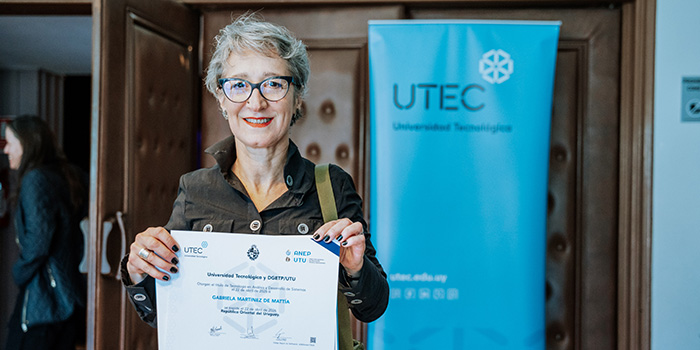
After completing a postgraduate program in Learning Environment Design at UTEC, Gabriela felt the need to take the next step: "I was designing educational concepts but lacked the tools to create them effectively; I needed a developer. That’s when I decided I had to learn to program," she recounts.
During the pandemic, she took advantage of the virtual format offered by the Systems Analysis and Development Technologist program to enroll. The challenge was not without its doubts and fears: "I hadn't studied mathematics in 38 years, and that was my biggest fear. But a colleague encouraged me, saying, 'You can do it; I’ll help you if needed.' And I did it," she recalls with pride.
When the program returned to in-person classes, Gabriela requested a work transfer and moved to the border region to continue her studies. She managed to complete the program without giving up her teaching hours: "I did it while working; it is entirely possible to complete it while holding a job," she notes. The program's class schedule—from 7:00 PM to 11:00 PM—is specifically designed to facilitate this balance.
A chatbot to improve reading fluency
As her final degree project, Gabriela developed a real-world technological solution: a WhatsApp chatbot for the automated assessment of reading fluency.
The system combines artificial intelligence—using the Whisper v3 Small speech transcription tool—with audio analysis via Praat, software specialized in phonetic research. The goal of this solution is to measure how well and in what manner students read. To achieve this, the chatbot calculates a fluency index based on three pillars: prosody (rhythm and intonation), weighted at 51.3%; accuracy, at 32.9%; and speed, at 15.6%.
Her project successfully passed initial testing through a pilot program at IFSul itself. Thirty-six users participated in a bilingual border setting, and the system demonstrated high efficiency, processing 30-second audio clips in just 35 seconds using standard computers. The results were striking: 65.4% of participants showed objective improvement in their reading after repeating the exercise.
"I still have a lot of work to do, but the goal is to democratize access to reading fluency assessment in educational settings with limited resources," Gabriela explains. For her, this achievement encapsulates the spirit of the degree program: "The most important thing is becoming someone who identifies problems and implements solutions."
A degree program with a professional and binational focus
The educational program also features a significant professional engagement component, including technical visits, hands-on work with real-world projects, and internships with partner companies.
Furthermore, it offers a unique binational experience by equitably integrating students from Uruguay and Brazil, naturally fostering cultural exchange.
Compartí este artículo
Suscribite
Noticias, actividades e ideas en tu mail cada semana.