The “greatest challenge” of artificial intelligence is “how to guarantee accuracy” in its responses, said MIT Professor Munther Dahleh, who teaches at UTEC
Artificial intelligence, ethics, and accuracy are at stake. Over the past decade, the rise in the quantity and quality of data has made it possible to make better decisions, but challenges remain. One of the leading faculty members at the Massachusetts Institute of Technology (MIT) teaches in UTEC’s Master’s in Data Science and brings students the latest trends in a field that combines artificial intelligence, mathematics, statistics, and their application to solving societal problems.
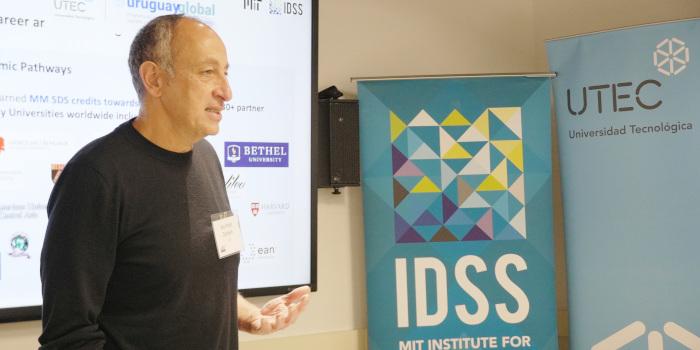
Acting under uncertainty, combining partial information, data, and models to make robust and adaptive decisions—these are the topics professor Munther Dahleh has focused on for more than 40 years. At the heart of this electrical engineer’s work is Data Science.
Of Palestinian origin and living in the United States for decades, Dahleh is a principal faculty member and founding director of the Institute for Data, Systems, and Society at the Massachusetts Institute of Technology (MIT). He teaches this field to UTEC students enrolled in the Master’s in Data Science offered in collaboration with MIT.
Dahleh has driven the growth of the discipline and the transfer of his personal experience. He has done so with a practical approach, engaging closely with students from around the world. He is convinced that data science education must expand globally and even begin at younger ages, as it is already part of daily life and current technological development.
In an interview conducted by UTEC’s Communication Unit, the professor reviewed the challenges of data science in a time of booming artificial intelligence and emphasized the need to teach it “from earlier levels” and “everywhere,” since technology is “global” and already part of everyday life.
Regarding his connection with Uruguay, he highlighted that the collaboration with UTEC arose from a genuine interest on the institution’s part, which led to an exchange beneficial to both sides.
Below is a summary of the conversation:
You have extensive experience and are recognized in the field of data science. How did your interest in these topics begin?
It started 40 years ago, at the beginning of my doctoral studies. I have been working on decision theory. We talk about how to make decisions when you only have partial information about the environment in which you must decide—that is, decisions under uncertainty. This partial information can be data or incomplete models. You try to combine all of that to make some sort of decision and continue adapting that process. Since my doctoral years, I was intrigued by this topic. And, of course, the world and science have evolved, and I have evolved with them.
What are the main challenges you and your team currently face as researchers in the field of data?
Right now, I think the most interesting problem is the emergence of generative artificial intelligence (which can create new and original content such as text, images, or videos) and large language models.
The greatest challenge we face is how to guarantee the accuracy of these tools, which are becoming so widespread. They are language models, and they are not designed to be logically precise. That is why we study how they can be made more accurate, more robust, and, of course, more ethical—both in how they respond to people and in their relationship with different communities.

How do you imagine the future of education in decision systems in the coming years? Do you think more training and more human resources are needed in this area?
Decision theory is something fundamental that we do all the time. Statistics, data science, and machine learning were developed to support our ability to make decisions. So, whether it is us or autonomous systems or machines, we all make decisions under the same conceptual umbrella.
There are never enough people working on these topics, because today we are automating practically every decision-making strategy: in services, in autonomy, and in many other fields.
Our MicroMasters program (through which MIT collaborates with UTEC) is one of the ways we try to spread this knowledge beyond MIT.
How do you foresee the incorporation and use of these topics—currently centered mainly in academia—in the coming years?
Much of this is already transitioning into practice. That’s why I mentioned that professional education will be so important, because people need to understand what is behind these tools in order to apply them well and correctly.
Why did you choose to participate as a faculty member in UTEC’s Master’s in Data Science in Uruguay? What motivated you to share your knowledge abroad, particularly in South America?
First of all, when we launched this Data Science program, we anticipated that there would be students from all over the world—and indeed, there are. That was the vision. Why teach in it? We first launched it, and then my courses became part of it. I am teaching one subject and developing another in that area. Working with Uruguay was an opportunity that came up. There was interest, that interest reached us, we began the collaboration, and it was an excellent experience from which both sides benefited.
You consider it very important when you perceive interest from the other side.
Of course. We know there is interest, and when we see institutions organizing around that interest and seeking to bring this type of education to their students, we get excited and want to participate.
How do you view the exchange between a large institution like MIT and other universities that may be smaller or less well-known?
That is precisely the purpose of our work and the MIT vision in creating the online Micromasters. At MIT, we have the ability to develop very up-to-date and interesting programs, and sometimes other institutions cannot keep pace with these advances due to resource limitations.
For us, collaborating with these institutions is a way to add value but also to learn about the challenges they face and adapt our courses to address them.
It is truly a pleasure for us to work with smaller institutions that want to offer these contents but lack all the necessary resources. We enjoy sharing a common vision and a shared approach to making it possible.
What has been your main message or contribution? What did you aim to convey in your classes within this program?
My main contribution to the program was launching it, as I was its founding director. I deeply believe in it.
During the graduation ceremony, I mentioned that the level of commitment of our faculty in developing it was incredible, a true testament to the vision driving the program.
In my courses, I try to be as efficient and effective as possible, conveying my experience and my perspective. It is not just about reading a textbook, but also learning about real applications and viewpoints.
I try to make the classes personalized, not generic: I develop courses that reflect my personal experience, and students can connect with that through learning.
Data science has been studied for many years at MIT and in developed countries. How do you see the expansion of this knowledge in education and research worldwide?
This is the foundation of much of the technology we see today, and that technology is global. Therefore, everyone will need these courses. I feel they should even be taught at earlier levels, such as secondary education, because they are already part of our daily lives.
The time is now: this is the right moment for all of this to be taught everywhere.
_________________________________________________________________________________

SPECIALIZATION IN DATA SCIENCE AND ARTIFICIAL INTELLIGENCE OPENS ENROLLMENT
Enrollment for the Specialization will be open from Monday, November 17 until February 17, 2026. The program is scheduled to begin on Tuesday, March 17. Applicants must meet the mandatory requirements of having tertiary-level training in mathematics (calculus and linear algebra), as well as an intermediate to advanced level of English.
The Specialization stands out for its innovative approach, offering a cutting-edge educational program in two of the most dynamic and in-demand areas in today’s technological landscape: Data Science and Artificial Intelligence, with a fully applied focus.
This program combines UTEC’s academic excellence and practical orientation with the global experience and prestige of the Massachusetts Institute of Technology (MIT).
Compartí este artículo
Suscribite
Noticias, actividades e ideas en tu mail cada semana.